
Menifee Projected Versus Actual Release
A projected date is an administrative estimate built from the sentence, prior jail credit, statutory credit rules, and later events. It is not the time when staff will complete a physical release. A parole-eligibility date marks when consideration may begin. Maximum expiration and final discharge have different meanings.
Menifee County has no operating jail. A local detainee may be housed at Rowan, Montgomery, Powell, or Three Forks. That jail calculates and records a short county-sentence exit. KDOC calculates state sentences. A court order may authorize release before either agency finishes processing.
Find Menifee County Release Dates
Start with custody class. A pretrial detainee usually has no sentence-based date because bond, dismissal, plea, trial, or another order still controls the outcome. A sentenced county detainee requires the housing jail and Menifee court record. A state prisoner requires KOOL and, when needed, KDOC staff.
- Identify whether the person is pretrial, serving a county sentence, or committed to KDOC.
- Review the Menifee docket for the judgment, sentence, jail credit, and later orders.
- For county custody, call the actual housing jail and ask which existing record shows its calculation.
- For state custody, search Kentucky Online Offender Lookup and save the KDOC number.
- Read status, current location, and every date label together.
- Confirm an unclear field with Offender Information Services at 502-564-2433.
The Menifee County release search helps identify the actual housing jail before a records request.
Menifee KOOL Release Labels
KOOL serves people whose records reached KDOC. It does not cover every brief Menifee jail stay. Search broadly by last name and first initial, compare identity details, then open the record. The public detail connects status and location with sentence dates.
| Public label | Meaning |
|---|---|
| Parole Eligibility Date | When parole consideration may become available, not a grant or exit. |
| Minimum Expiration of Sentence Date (Good Time Release Date) | KDOC's minimum-expiration calculation with applicable credits. |
| Maximum Expiration of Sentence Date | A separate sentence endpoint. |
| Status and Current Location | The context needed to interpret all dates. |
A transfer into KDOC is not community release. Parole can end prison custody while supervision continues. Discharge means the relevant state sentence or supervision relationship has ended.
Menifee Good Time Release Label
KOOL's exact public label is “Minimum Expiration of Sentence Date (Good Time Release Date).” It appears separately from parole eligibility and maximum expiration. The wording matters because silently renaming it “projected release date” hides which calculation is being read.
The representative KOOL detail shows the three labels. A live record must be read with its status and location. The date may move after new credits, discipline, or a court event.
Kentucky's current Chapter 439 entry provides the related parole-law context.
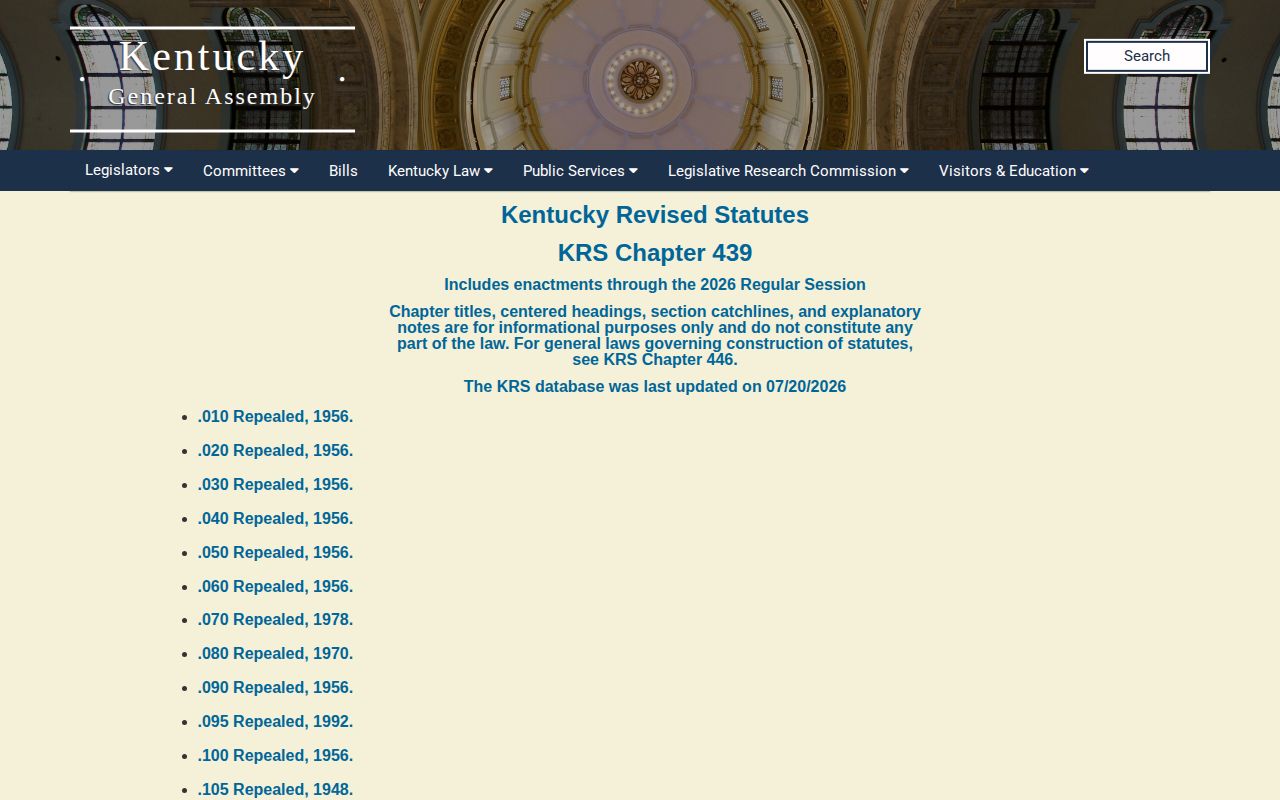
The state source helps separate sentence law from a promise that a Menifee-linked person will leave on that date.
Menifee State Sentence Credits
KRS 197.045 lists several credits, not one universal good-time number. It includes prior-confinement credit and specified ninety-day credits for approved education, vocational, treatment, evidence-based, and life-skills achievements. It also permits discretionary good-behavior credit up to ten days per month, meritorious credit up to seven days per month, and emergency-service credit up to seven days per month.
Except for prior-confinement credit, KDOC may forfeit earned credit or deny future credit after an offense or rule violation. Consecutive sentences are merged for credit and expiration calculations. Eligible sexual offenders face separate treatment-program rules. These provisions govern state penal sentences and should not be applied by hand to a short Menifee sentence in a regional jail.
Consecutive sentences are treated as an aggregate for credit and expiration work. A person reading one judgment may miss the combined effect. Approved program credit depends on actual completion and KDOC treatment of the award. Good-behavior, meritorious, and emergency-service credits are authorized categories, not amounts every person receives.
Eligible sexual offenders may earn credits before completing the Sex Offender Treatment Program, but the credits generally are not applied until successful completion, subject to exceptions and offense-date rules. A simple sentence-minus-credit formula can therefore fail. The live KOOL field and KDOC explanation are safer than an independent calculation.
Menifee Violent Offender Rule
KRS 439.3401 is the source of Kentucky's familiar eighty-five-percent description for covered violent offenders. It does not apply to every felony. Coverage depends on the offense, definitions, offense date, and findings. The statute limits parole eligibility and credits that would reduce confinement below the required share.
A qualifying finding under KRS 439.3402 can create a domestic-violence-victim exemption. Life sentences and statutory versions require added care. A charge label is not enough to calculate a date. Use the judgment and current law, then ask KDOC how its field was calculated.
Offense dates matter because statutory versions change. Court findings, persistent-offender rules, and life sentences can also alter eligibility. The right question is what law and judgment KDOC applied to this person, not whether the charge name sounds violent.
Why Menifee Release Dates Change
A projection changes when its legal or administrative inputs change. Some events move it earlier. Others move it later or replace it with a different authority.
| Factor | Possible effect |
|---|---|
| Jail-credit correction | Changes credited time served. |
| Credit or forfeiture | Moves the minimum calculation. |
| Consecutive or amended sentence | Rebuilds the aggregate term. |
| Parole action | May grant, deny, defer, or rescind supervised release. |
| Shock probation or home incarceration | Changes the authority and form of release. |
| Detainer, warrant, or new case | May transfer custody instead of releasing the person. |
Note: A favorable parole result can still require conditions and processing before physical release.
Menifee Mandatory Reentry Release
Kentucky distinguishes discretionary parole from mandatory reentry supervision. Under the July 15, 2026 version of KRS 439.3406, an eligible person denied discretionary parole may enter mandatory supervision six months before projected completion. Detailed exclusions cover offense history, security class, short sentences, and other post-incarceration cases.
Parole denial therefore does not always imply confinement through maximum expiration. Supervised release also should not automatically be called parole. KOOL, KDOC, and District 8 identify the status.
Mandatory reentry is supervised community release, not final discharge. Conditions and an assigned office can remain. Parole follows a discretionary Board grant. Both can end physical prison custody, but their legal authority differs. The status record should name the route.
The District 8 source provides Menifee supervision contacts.
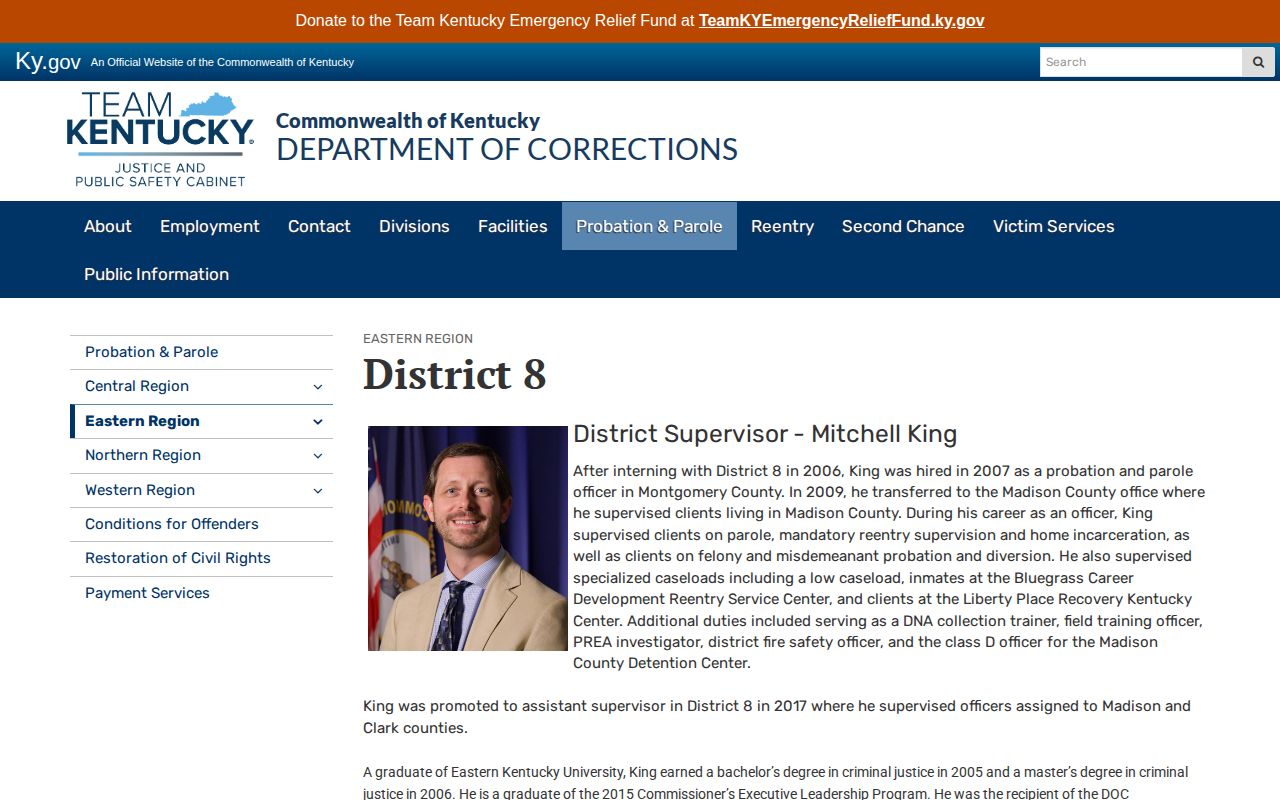
The office listing helps verify supervision after release, but it does not replace the record of the actual exit.
Confirm Menifee County Release
For a county sentence, request the release or transfer entry from Rowan, Montgomery, Powell, or Three Forks. For state custody, compare KOOL with KDOC Offender Information Services. The Menifee Circuit Clerk supplies the judgment and amended orders. No Menifee-specific good-time or weekend-release policy was found, so do not invent one.
A narrow jail request can ask for the commitment, a maintained jail-credit calculation, and the entry showing actual release or transfer. Include the name, booking or case identifier, and date range. Ask for existing records rather than a new explanation. If the event was a transfer, request the destination if recorded.
For KDOC, request records sufficient to show the actual release date, authority or type, sentence-expiration or discharge date, and final custody or supervision status. Public open records is 502-782-2229. Inmate records is 502-782-2370. Those routes help when KOOL does not answer whether supervision remains.
Transportation should not rely on the estimate. Menifee's contract arrangement can place the person outside the county, and no common release hour, exit door, waiting area, or transit policy was found. Call the actual jail shortly before travel and confirm physical processing.
The court file adds another time layer. A Menifee judge may enter bond, dismissal, shock probation, revocation, or an amended sentence. That order controls legal authority, yet the jail still must receive and process it. The docket date, order date, and physical release time can differ. Request the signed order when the docket text is too brief to explain the change.
A detainer is a request or notice that another authority may take custody. It can prevent an expected community exit or cause a direct transfer. A new warrant can have a similar effect. Neither event necessarily erases the sentence calculation shown in KOOL, so a public date can remain visible while the destination changes. Ask the jail or KDOC whether another authority assumed custody.
Parole eligibility is also conditional. Eligibility means the case can be considered under the governing rules. It does not mean the Kentucky Parole Board granted release. A grant may still depend on conditions and institutional processing. A denial, deferment, or later rescission changes the path. The Board result, KOOL status, and physical release record answer different parts of the timeline.
Maximum expiration should not be called discharge without support. A person may leave physical custody before that endpoint under parole or mandatory reentry, then remain supervised. Conversely, a hold can keep the person from entering the community even when one sentence reaches an endpoint. Confirm both custody and supervision before describing the outcome.
KOOL updates during the day, but it is not a real-time door-exit ledger. A field can be accurate as a sentence calculation while the current location still reflects processing. Save the KDOC number and ask what the label means on that record. The public view may show only the last ten convictions, so older or additional state information can require an Offender Information Services request.
County-only custody needs equal care. A person can leave Rowan and appear at Montgomery, Powell, or Three Forks because of placement decisions. The first roster's disappearance changes no sentence by itself. Search the other current portals, check VINE, and call the custodian. Only a release entry or other authoritative event should support a statement that the person entered the community.
A Menifee VINELink inmate search can add notice. Direct agency confirmation remains necessary because a notice, projection, or court authorization can precede physical processing.
Note: If another jail, KDOC, or federal authority takes custody, call the event a transfer, not community release.